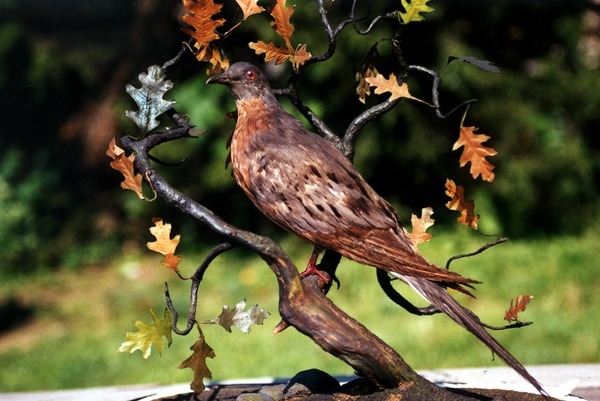
This passenger pigeon was shot in an orchard on Offnere Street in Portsmouth, Ohio by Arthur Bannon around 1882. He presented it to his mother, a taxidermist, who wanted a specimen of the nearly extinct bird for her collection. The male passenger pigeon is dark brown with a copper-colored breast and stands 7 inches (17.78 cm.) high and is 15 inches (38.1 cm) long from its head to its tailfeathers. Passenger pigeons were once the most numerous species of bird in North America and provided a seemingly endless supply of meat, fat, and feathers to early settlers. Contemporary observers described migrating flocks of passenger pigeons as blackening the skies due to their large numbers. Later in the century, commercial hunting of passenger pigeons became popular. The growth of the railroads promoted pigeon hunting, since the trains could transport pigeon meat to major markets with no danger of spoilage. By the late 1880s, the decline in the passenger pigeon population became irreversible. It is now extinct.
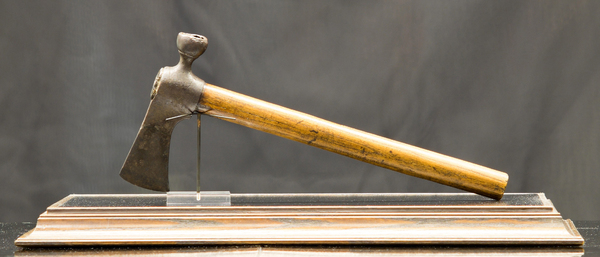
Blacksmith Christy Hare made this tomahawk tobacco pipe for pioneer settler Joseph Miller (1762-1845). It measures 6.5 by 14 inches (16.51 by 35.56 cm). Miller kept the tomahawk, which he used as both a weapon and a pipe for smoking tobacco, with him, even when attending religious services. He reportedly battered the bowl of the pipe while attempting to shoot a bear in a cave. Joseph Miller was a scout for the federal government, exploring the Northwest Territory and fighting American Indians. He was one of the earliest residents of Gallipolis. Miller was reportedly involved in one of the last fights between settlers and American Indians in Ohio. After the signing of the Treaty of Greenville established peace between the settlers and the American Indians, the government no longer needed scouts. Miller moved to Lawrence County, where he farmed and hunted.
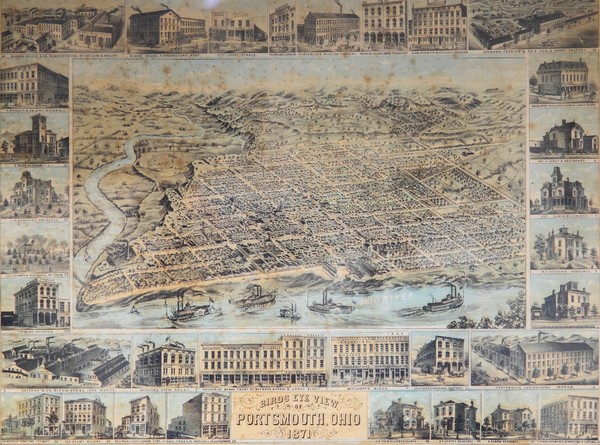
Faintly tinted drawing of Portsmouth as if viewed from the air in 1871. Businesses and prominent residences are numbered 1 thru 32 on the drawing and identified by number in the margins.
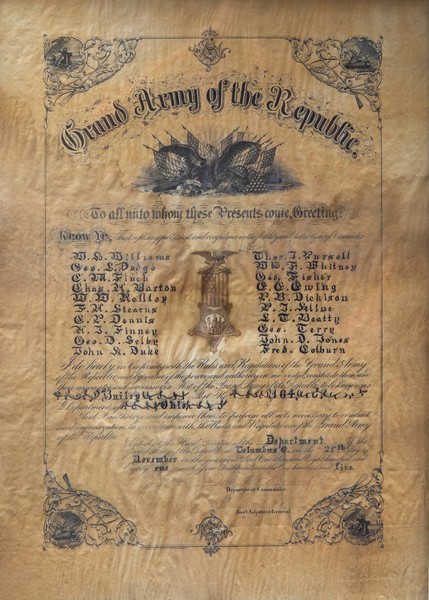
This certificate documents the founding of the Bailey Post 164 of the Grand Army of the Republic in November 1881. It was named in honor of George Bailey, who organized the Kinney Light Guards, which eventually became the 1st Ohio Volunteer Infantry (O.V.I.), Company G, also called the Portsmouth Guards. The certificate, which measures 14.5 by 20.5 inches (36.83 by 52.07 cm) shows water damage, presumably caused by a flood of the nearby Ohio River. It lists the twenty original members of the organization. Following the Civil War, numerous veterans' organizations sprang up around the country. The Grand Army of the Republic was one of the largest and most influential.
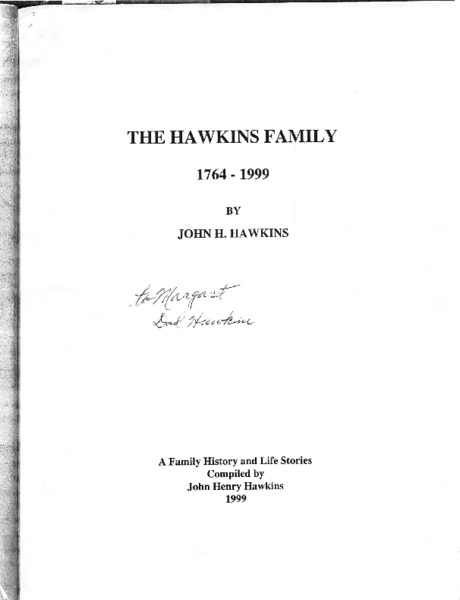
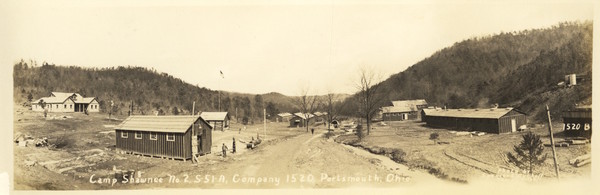
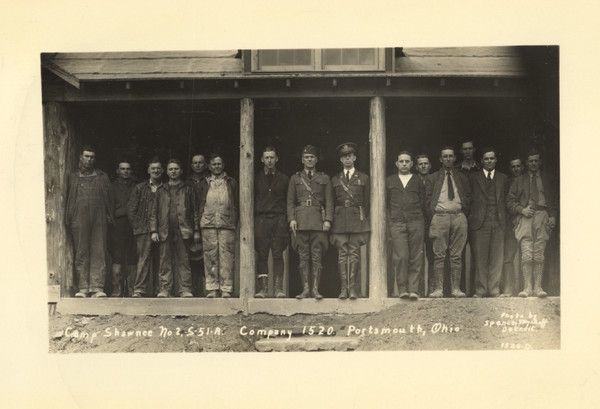
Photo copy of pages 94 thru 103 of The Hawkins Family: A Family History and Life Stories by John Henry Hawkins. The chapter titled "CCC Camp" is about his work as manager of Shawnee Camp #2 in the Shawnee Forest 1933- 1935.
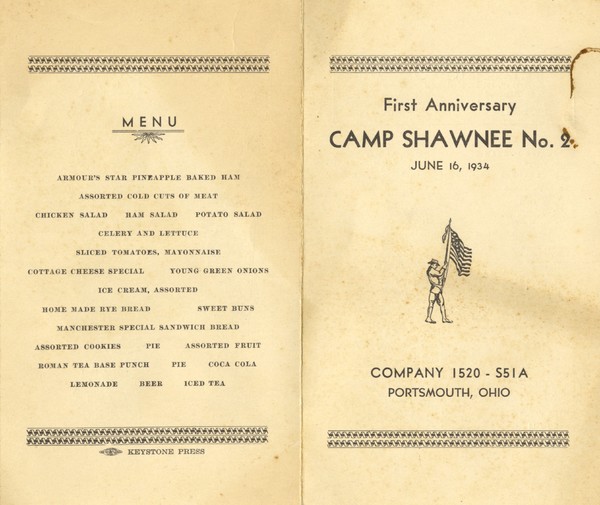
Dinner Menu for the First Anniversary Camp Shawnee No. 2, Company 1520 - S51A, Portsmouth, Ohio.. The young men enrolled in the CCC (Civilian Conservation Corps.) program in Shawnee Forest are also listed.
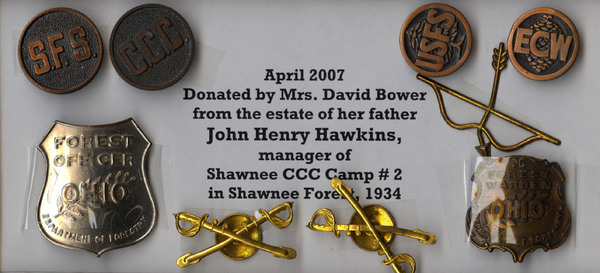
Various metal shields, buttons, and pins from the estate of John H. Hawkins, manager of the Civilian Conservation Camp Shawnee No. 2 in Shawnee Forest 1933-1935.